

Product Categories
SEARCH WHAT YOU WANT

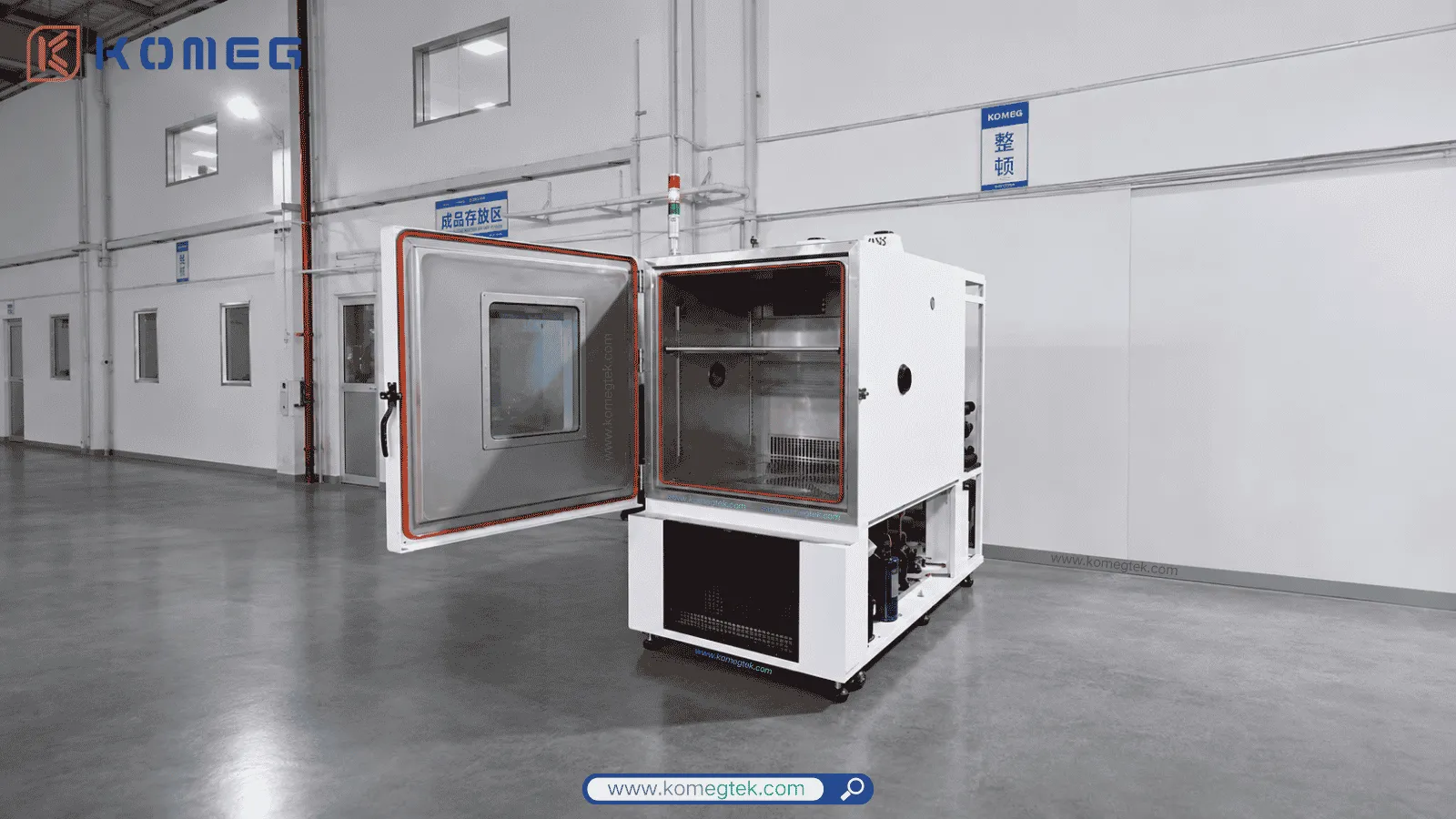
As manufacturers worldwide pursue higher product reliability while reducing their environmental footprint, environmental testing technology is entering a new era. Traditional environmental test chambers have long relied on synthetic refrigerants with high Global Warming Potential (GWP). However, increasing environmental regulations and corporate sustainability goals are driving the adoption of greener refrigeration technologies.
One of the most promising innovations is the Environmental Test Chamber with a CO₂ Refrigeration System. By using natural refrigerant R744 (Carbon Dioxide), these chambers combine high-performance temperature control with significantly lower environmental impact, making them an ideal choice for manufacturers seeking both testing accuracy and sustainable operation.
This article explores how CO₂ refrigeration technology works, its advantages over conventional systems, and why it is becoming the future of environmental testing.
An Environmental Test Chamber with a CO₂ Refrigeration System is an environmental simulation chamber that uses carbon dioxide (R744) as its primary refrigerant instead of conventional fluorinated refrigerants such as R404A or R23.
These chambers are designed to simulate a wide range of environmental conditions, including:
They are widely used in:
Unlike traditional refrigeration systems, CO₂ refrigeration provides an environmentally responsible solution while maintaining excellent cooling performance.
Environmental regulations are becoming increasingly stringent across the globe.
Many traditional refrigerants have high Global Warming Potential (GWP), meaning that even small leaks can contribute significantly to greenhouse gas emissions.
For example:
| Refrigerant | Approximate GWP |
|---|---|
| R23 | 14,800 |
| R404A | 3,922 |
| R507 | 3,985 |
| CO₂ (R744) | 1 |
Because CO₂ has a GWP of just 1, it is considered one of the most environmentally friendly refrigerants available today.
As governments continue to phase down hydrofluorocarbons (HFCs) under regulations such as the Kigali Amendment to the Montreal Protocol, manufacturers are actively seeking alternative refrigeration technologies that support long-term compliance and sustainability.
The biggest advantage of CO₂ refrigeration is sustainability.
Unlike synthetic refrigerants, carbon dioxide is a naturally occurring substance with negligible environmental impact when used in refrigeration systems.
Benefits include:
For companies committed to ESG initiatives, adopting CO₂-based environmental chambers is an important step toward greener manufacturing.
CO₂ possesses excellent thermodynamic properties, making it highly effective for environmental testing applications.
Modern CO₂ refrigeration systems can deliver:
These characteristics are especially valuable for reliability testing programs requiring frequent thermal cycling.
Although system design plays a significant role, advanced CO₂ refrigeration systems can achieve excellent energy efficiency under many operating conditions.
Advantages include:
For laboratories operating multiple environmental chambers continuously, improved energy efficiency can significantly reduce long-term operating expenses.
Many conventional refrigerants are gradually being phased out worldwide.
Investing in a CO₂ refrigeration system helps manufacturers avoid future refrigerant restrictions and costly equipment upgrades.
This provides:
Environmental Test Chambers with CO₂ Refrigeration Systems are suitable for virtually every industry requiring precise environmental simulation.
| Feature | CO₂ Refrigeration | Traditional Refrigerants |
|---|---|---|
| Global Warming Potential | Very Low (GWP = 1) | High |
| Environmental Compliance | Excellent | Increasingly Restricted |
| Cooling Performance | Excellent | Excellent |
| Energy Efficiency | High | Moderate to High |
| Long-Term Availability | Future-Proof | Regulatory Uncertainty |
| Sustainability | Outstanding | Limited |
Not all environmental chambers are created equal. Beyond the refrigeration technology, buyers should evaluate several key factors:
Selecting a supplier with extensive engineering expertise ensures the chamber can be tailored to your specific testing requirements and integrated into your existing laboratory workflows.
As environmental testing requirements become more demanding, manufacturers need equipment that delivers not only precision but also sustainability.
KOMEG has developed Environmental Test Chambers with CO₂ Refrigeration Systems to help customers achieve both objectives.
Designed for high-performance reliability testing, KOMEG chambers combine advanced refrigeration technology with intelligent control systems and robust construction. They are suitable for applications ranging from electronics and semiconductors to automotive, aerospace, and energy storage.
Key advantages include:
Whether you are upgrading an existing laboratory or building a new reliability testing facility, KOMEG offers customized environmental testing solutions designed to support long-term performance, regulatory compliance, and sustainable manufacturing.
The future of environmental testing is not only about achieving precise temperature control—it is also about reducing environmental impact and preparing for evolving global regulations.
Environmental Test Chambers with CO₂ Refrigeration Systems represent a significant advancement in sustainable testing technology. By combining high-performance refrigeration, energy efficiency, and environmentally friendly refrigerants, they help manufacturers improve product reliability while supporting corporate sustainability goals.
As industries continue to prioritize both innovation and environmental responsibility, CO₂-based environmental chambers are poised to become the preferred choice for next-generation reliability testing.
If your organization is looking for an environmental testing solution that balances performance, efficiency, and sustainability, KOMEG's Environmental Test Chambers with CO₂ Refrigeration System provide a future-ready solution designed to meet today's testing demands—and tomorrow's environmental standards.
A CO₂ refrigeration system uses R744 (carbon dioxide) as the refrigerant instead of conventional HFC refrigerants. It provides efficient cooling while significantly reducing environmental impact due to its ultra-low Global Warming Potential (GWP = 1).
CO₂ is a natural refrigerant with zero ozone depletion potential (ODP) and a Global Warming Potential of just 1. It complies with increasingly stringent environmental regulations and supports corporate sustainability goals.
These chambers are widely used in automotive, semiconductor, aerospace, electronics, battery manufacturing, medical devices, and research laboratories where precise temperature control and sustainable operation are equally important.
Yes. Modern CO₂ refrigeration technology offers excellent cooling capacity, stable temperature control, rapid pull-down performance, and high energy efficiency, making it suitable for demanding environmental simulation and reliability testing applications.
KOMEG combines environmentally friendly CO₂ refrigeration technology with precise temperature control, intelligent operation, customizable designs, and reliable engineering support. The result is a future-ready environmental testing solution that helps manufacturers improve product reliability while reducing their environmental footprint.
Product Categories
Recent Posts
Copyright © 2026 GUANGDONG KOMEG INDUSTRIAL CO., LTD