

Product Categories
SEARCH WHAT YOU WANT
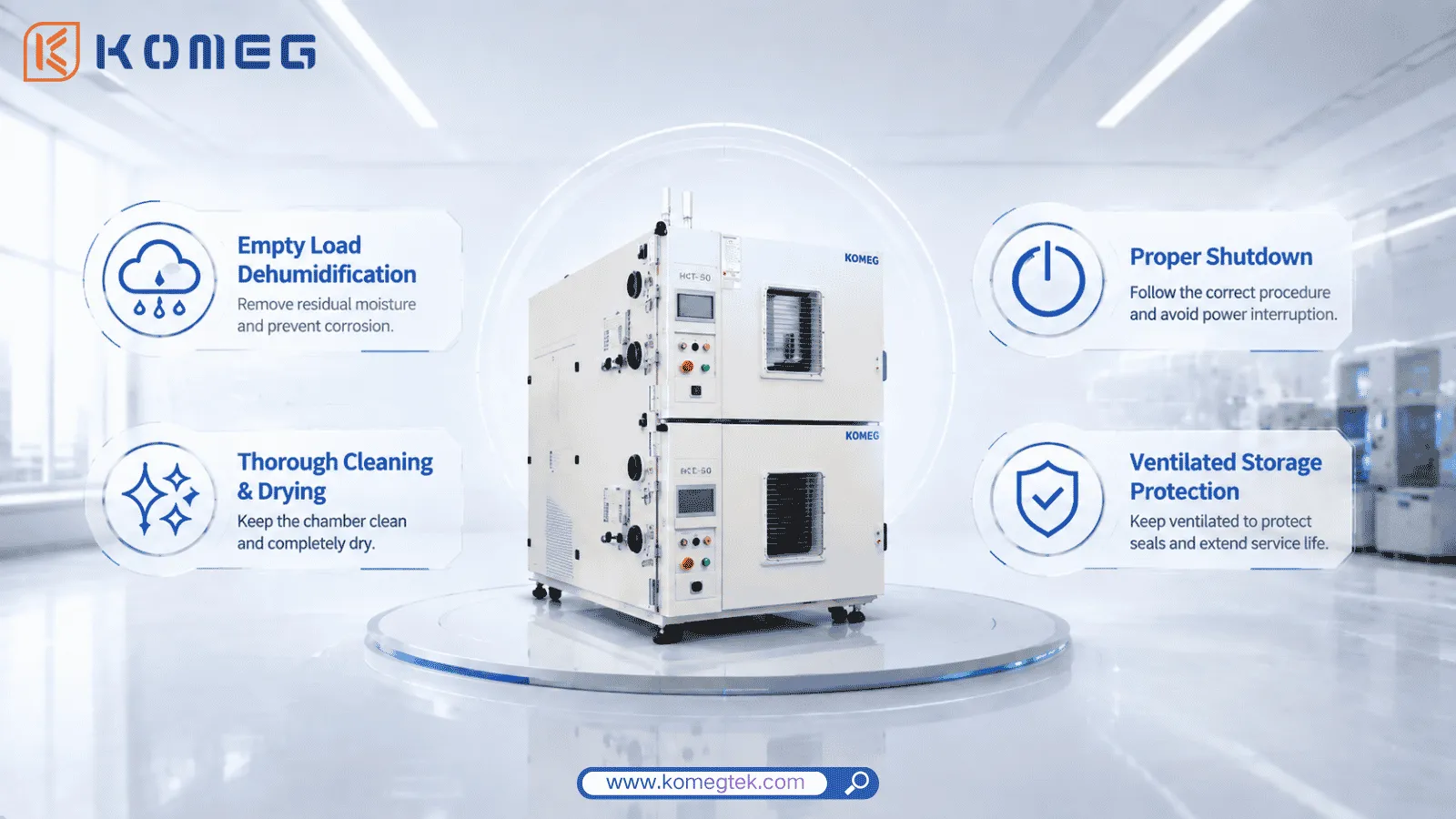
When an environmental test chamber is temporarily unused due to project completion, seasonal production adjustments, or laboratory scheduling changes, proper storage becomes an important part of equipment management. Many maintenance issues are not caused by frequent operation, but by improper shutdown procedures and unsuitable storage conditions over long periods.
Based on years of manufacturing experience and customer service support, KOMEG has summarized a practical long-term storage procedure for environmental test chambers. The following recommendations are applicable to different types of equipment, including temperature test chambers, humidity chambers, aging test chambers, and salt spray chambers. Proper preparation before shutdown can help maintain equipment performance, reduce unexpected failures, and extend service life.
Environmental test chambers are precision systems that integrate temperature and humidity sensors, refrigeration units, heating systems, air circulation structures, sealing components, and electrical control modules. Because many internal components are sensitive to moisture and environmental conditions, directly disconnecting power and leaving the chamber sealed for a long period may create potential risks.
One common problem is residual moisture. After testing, water vapor may remain inside the chamber, air ducts, and internal surfaces. If the equipment is immediately powered off and stored in a closed condition, moisture accumulation may cause mold growth, oxidation, corrosion, and reduced reliability of internal components.
Long-term exposure to a humid environment may also affect temperature and humidity sensors, resulting in measurement deviation and reduced testing accuracy. In addition, keeping the chamber door tightly closed for months may place continuous pressure on the sealing gasket, causing deformation, aging, or reduced sealing performance when the equipment is restarted.
Therefore, proper shutdown preparation is essential before long-term storage.
Before placing the equipment into long-term storage, it is recommended to operate the chamber without test samples for approximately 20–30 minutes. During this process, the circulation system helps remove remaining moisture from the chamber interior, air ducts, and internal components.
This simple step can effectively reduce condensation risks and prevent moisture-related issues such as corrosion and odor development during storage. Although it requires only a short operating time, it plays an important role in maintaining equipment condition.
Environmental test chambers should not be stopped by directly cutting off the main power while the system is running. Sudden power interruption may affect the controller, electrical components, and operating system.
The recommended shutdown process is to allow the current program to finish normally, confirm that the controller returns to standby mode, turn off the equipment switch, and then disconnect the power supply if required.
Following the correct shutdown procedure helps protect the electrical system and ensures smoother operation when the equipment is used again.
Before long-term storage, the chamber interior should be cleaned thoroughly. Remove any remaining test samples, dust, particles, and water residue from the working area and shelves.
The inner chamber should remain clean and dry during the storage period. Residual contaminants or moisture may accelerate corrosion, create unwanted odors, or affect future testing conditions.
For equipment used in applications involving humidity, salt spray, or corrosive materials, additional cleaning attention should be given to prevent residue buildup.
After cleaning and complete drying, it is recommended not to keep the chamber door fully sealed for extended periods. Leaving a small ventilation gap or placing a suitable spacer between the door seal and chamber body can help maintain airflow inside the chamber.
This practice reduces the risk of gasket deformation, sticking, and aging caused by long-term compression. When the equipment is returned to operation, the sealing structure can maintain better performance.
Environmental test chambers that have been unused for several months should be inspected before returning to normal testing.
For equipment stored for more than three months, it is recommended to perform an empty-load trial operation for approximately one hour. This allows the system to complete self-check procedures, remove possible internal moisture, and confirm that temperature control, humidity control, alarms, and safety functions are operating correctly.
During storage, equipment should be placed in a dry, ventilated indoor environment away from direct sunlight, excessive humidity, and heavy dust. Regular basic inspections can help identify potential issues early and reduce the possibility of major repairs.
For laboratories and manufacturers, maintaining stable performance of environmental test equipment is essential for reliable testing results and efficient production processes.
As an environmental test chamber manufacturer, KOMEG focuses not only on equipment design, manufacturing quality, and customized solutions but also on supporting customers throughout the entire equipment lifecycle. Through prac
Proper storage, regular maintenance, and correct operation practices allow environmental test chambers to deliver reliable performance throughout their service life.
Product Categories
Recent Posts
Copyright © 2026 GUANGDONG KOMEG INDUSTRIAL CO., LTD